


Call us now
+44 (0) 2476 222272


About Us
// Case Study 4


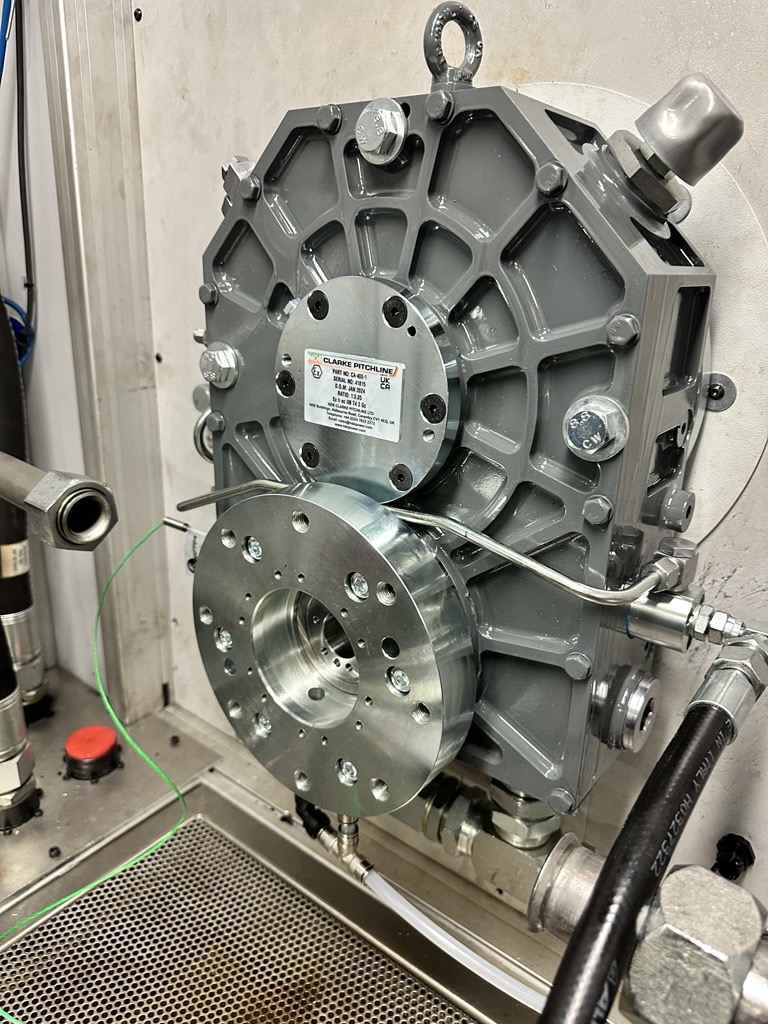
Expansion of high speed Gearbox Range
Design & Manufacture of High Speed Test Rig Gearbox
CA-400 gearbox solves reliability and uptime issues for major aerospace supplier
The problem
A leading Tier 1 supplier to global airframers faced the need to test fuel pumps for product acceptance testing (PAT) approval, noise, vibration and harshness (NVH), and leak rate to ensure they were fit for purpose.
However, the company was experiencing a specific and significant set of challenges with the existing in situ gearboxes being used for the testing.
Not only were the gearboxes noisy and unreliable when operating, there was a problem with oil leaking into the unit under test (UUT).
This was invalidating test results, with UUTs not passing the company’s own test condition. Overall, one unit in eight was being deemed to ‘fail’ the test – far in excess of what might reasonably be expected.
However, the company could not be sure that the failure was solely down to issues with the test rig gearbox. This means any fuel pumps which failed under test were then having to be stripped back down and re-worked, at significant cost.
Furthermore, each of the gearboxes needed to be taken out of service every six to 12 months due to bearing failure. This meant that the company had to have cash tied up in spare gearboxes to minimise the interruption to testing. Even then, however, each changeover was taking two to three days – meaning many weeks of wasted time when factored across the year.
A further challenge was that the gearbox could only test at speeds of up to 8,000rpm – below some of the speeds now being demanded by the company’s customers.
The solution
The company needed a faster, more reliable, more robust solution. It also had to be future proof: able to withstand requirements for testing at ever higher speeds in line with evolving aerospace sector parameters.
The solution also needed to have a minimal maintenance requirement to cut time being wasted on both changeovers and also cash tied up in spare gearbox units.
The answer came in the form of four CA-400 series gearboxes from NDE Clarke Pitchline. The CA range was developed to fill the gap in the market for reliable and oil-leak-free high-speed testing and is available in both flange-mounted and foot-mounted variants. Their robust design, with ultra-high precision ground helical gears, and next generation sealing technology, makes them suitable for both development and PAT testing of motors, fuel pumps, spindles and other high speed rotating assemblies used in the aviation sector.
Each can handle speeds of up to 15,000rpm with a maximum torque capacity of up to 1,290Nm, and boasts proprietary seal technology which minimises oil leaks around the interface the UUT, with very low ‘noise-vibration-harshness’.
The modular units are highly efficient with minimal losses thanks to optimised gear geometry and gear grinding processes, undertaken at NDE’s facility in Coventry where all components are manufactured and the final gearboxes are assembled.
The CA-400 is ATEX ‘G’ Zone 2 certified and has optional built-in condition monitoring features, with high-precision torque measuring options also available. ATEX-certification means they are suitable for fuel-rich applications such as the testing of fuel pump tests and fuel-cooled motors. And with a major maintenance interval of four years, thanks to an integrated cloud-based condition monitoring system, and no maintenance typically required between those times, disruption to the testing schedule is minimised.
The outcome
The company now has a reliable testing system in place and can operate testing at full capacity.
There have been no unscheduled interruptions to testing, resulting in maximised uptime.
Leakage had been all but eliminated, meaning the number of fails resulting from this has also drastically reduced and is now in line with what is expected with the vast majority of units performing in line with expectations. It is also making for a much safer working environment, as oil and other fluids from the testing process are no longer leaking onto floors and causing a slip hazard.
Cashflow has also been freed up as there is longer any need to hold units in reserve in case of maintenance requirements.
All told, there is an estimated operational saving of £150,000 - £200,000 p.a. for this customer, with further planned expansion to the fleet set to deliver delivering even greater savings.